Get instant feedback on your writing through portal.colanguage.com, or book a conversation class to practice this material with your teacher.
1. Vocabulary (26) Share Copied!
2. Exercises Share Copied!
Exercise 1: Exam preparation
Instruction: Read the text, fill in the gaps with the missing words, and answer the questions below
Notfall in der Zahnarztpraxis
Words to use: Notfallplan, Röntgenaufnahme, Allergien, versorgt, Betäubung, Zahnschmerzen, Abszess, scharf
(Emergency at the Dental Practice)
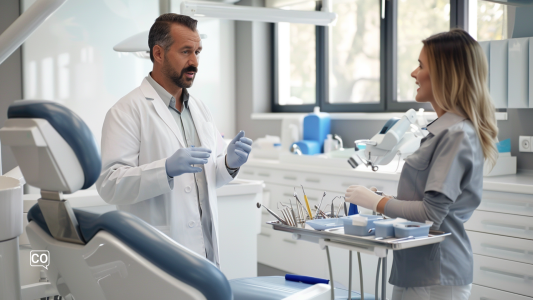
Dr. Weber arbeitet als Zahnärztin in einer Praxis in Berlin. Es ist Montagabend, kurz vor acht Uhr. Die Praxis ist fast leer, nur eine Assistentin ist noch da. Plötzlich kommt ein Patient ohne Termin in die Praxis. Er hält die Hand an die Wange und spricht sehr schnell.
Der Patient sagt: „Ich habe seit gestern starke . Heute sind die Schmerzen noch schlimmer. Der Schmerz ist und ich kann auf der rechten Seite nicht kauen.“ Dr. Weber sieht, dass die rechte Gesichtshälfte rot ist und leicht geschwollen. Beim Öffnen des Mundes sieht sie viel Karies und eine eitrige Schwellung am Zahnfleisch. Sie macht zuerst eine und fragt nach gegen Medikamente. Dann erklärt sie dem Patienten ruhig den : Sie gibt eine örtliche , eröffnet den und die Wunde. Zum Schluss bekommt der Patient Schmerztabletten und einen Termin zur Nachkontrolle am nächsten Tag. Die Assistentin bleibt noch kurz in der Praxis, falls der Patient im Wartezimmer plötzlich stärkeres Anschwellen oder neue Schmerzen hat.Dr. Weber works as a dentist in a practice in Berlin. It is Monday evening, just before eight o'clock. The practice is almost empty; only one assistant is still there. Suddenly a patient without an appointment comes in. He holds his hand to his cheek and speaks very quickly.
The patient says, “I have had severe toothache since yesterday. Today the pain is even worse. The pain is sharp and I cannot chew on the right side.” Dr. Weber notices that the right side of his face is red and slightly swollen. When she opens his mouth, she sees extensive tooth decay and a pus-filled swelling on the gum. First she takes an X-ray and asks about any allergies to medication. Then she calmly explains the emergency plan to the patient: she gives a local anaesthetic, opens the abscess and treats the wound. Finally the patient receives painkillers and an appointment for a follow-up the next day. The assistant remains at the practice for a short while in case the patient in the waiting room develops increased swelling or new pain.
Open questions:
-
Warum kommt der Patient ohne Termin in die Praxis? Beschreiben Sie die Situation.
(Why does the patient come to the practice without an appointment? Describe the situation.)
-
Welche Schritte macht Dr. Weber in der Behandlung nacheinander?
(What steps does Dr. Weber take in the treatment, in order?)
-
Warum bleibt die Assistentin nach der Behandlung noch in der Praxis?
(Why does the assistant stay in the practice after the treatment?)
Writing exercise:
Schreiben Sie 4 oder 5 Sätze über einen Patienten mit Zahnschmerzen in Ihrer Praxis und erklären Sie kurz, was Sie in diesem Notfall machen.
(Write four or five sentences about a patient with toothache in your practice and briefly explain what you would do in this emergency.)
Useful expressions:
-
Der Patient klagt über …
(The patient complains of …)
-
Ich frage zuerst nach …
(I first ask about …)
-
Dann mache ich …
(Then I do …)
-
Zum Schluss erhält der Patient …
(Finally the patient receives …)
Exercise 2: Rédiger de la correspondance
Instruction: Write a reply to the following message appropriate to the situation
E-Mail: You receive an email from a dentist at the practice where you work about an emergency patient. Reply and confirm what you can do this evening.
Betreff: Zahn-Notfall heute Abend
Guten Tag Herr Müller,
heute Abend kommt ein neuer Patient als Notfall in unsere Zahnarztpraxis. Er hatte gestern einen Unfall beim Sport und hat starke Schmerzen.
Der Patient berichtet über:
- starke Schwellung im rechten Unterkiefer
- eine kleine Blutung am Zahnfleisch
- Schmerzen beim Kauen
Ich möchte eine Röntgenaufnahme machen, um eine Kieferfraktur oder einen Abszess auszuschließen. Danach planen wir die Notfall-Behandlung: zuerst Schmerzen lindern, dann die Blutung stoppen und alles gut desinfizieren. Gegebenenfalls braucht der Patient eine Überweisung in die Klinik.
Können Sie bitte heute Abend ab 18:30 Uhr in der Praxis sein und mir bei der Aufnahme des Patienten helfen (Anamnesebogen, Notfallplan ausdrucken, Assistenz bei der Betäubung)? Bitte bereiten Sie auch ein leichtes Schmerzmittel für den Patienten vor.
Sagen Sie mir bitte per E-Mail:
- ob Sie heute Abend kommen können
- was Sie genau übernehmen können
Vielen Dank und freundliche Grüße
Dr. Anna Keller
Subject: Dental emergency this evening
Dear Mr. Müller,
This evening a new patient will come to our dental practice as an emergency. He had an accident playing sports yesterday and is experiencing severe pain.
The patient reports:
- pronounced swelling in the right lower jaw
- a small bleed at the gum
- pain when chewing
I would like to take an X-ray to rule out a jaw fracture or an abscess. Afterwards we will plan the emergency treatment: first relieve the pain, then stop the bleeding and thoroughly disinfect the area. If necessary, the patient will need a referral to the clinic.
Could you please be at the practice this evening from 6:30 pm and assist me with the patient's admission (medical history form, print the emergency plan, assist with the anesthesia)? Please also prepare a mild painkiller for the patient.
Please tell me by email:
- whether you can come this evening
- which tasks you can take on
Thank you and best regards
Dr. Anna Keller
Understand the text:
-
Warum möchte Frau Dr. Keller eine Röntgenaufnahme machen?
(Why does Dr. Keller want to take an X-ray?)
-
Was soll Herr Müller heute Abend in der Praxis konkret machen?
(What should Mr. Müller do at the practice this evening?)
Useful phrases:
-
vielen Dank für Ihre E-Mail. Ich kann heute Abend …
(Thank you for your email. I can this evening …)
-
ich kann folgende Aufgaben übernehmen: …
(I can take on the following tasks: …)
-
falls nötig, kann ich auch …
(If necessary, I can also …)
vielen Dank für Ihre E-Mail. Ich kann heute Abend ab 18:30 Uhr in der Zahnarztpraxis sein.
Ich kann den Patienten an der Rezeption begrüßen und mit ihm den Anamnesebogen ausfüllen. Ich drucke den Notfallplan aus und bereite das Zimmer für die Röntgenaufnahme vor. Außerdem kann ich Sie bei der Betäubung assistieren und das Material zur Desinfektion und zur Blutstillung bereitstellen.
Ich lege auch ein geeignetes Schmerzmittel für den Patienten bereit.
Falls sich die Behandlung verlängert, kann ich bis 20:00 Uhr bleiben.
Freundliche Grüße
Thomas Müller
Dear Dr. Keller,
Thank you for your email. I can be at the dental practice this evening from 6:30 pm.
I can welcome the patient at reception and help him complete the medical history form. I will print the emergency plan and prepare the room for the X-ray. I can also assist you with the anesthesia and prepare the supplies for disinfection and bleeding control.
I will prepare a suitable painkiller for the patient as well.
If the treatment takes longer, I can stay until 8:00 pm.
Best regards
Thomas Müller
Exercise 3: Multiple Choice
Instruction: Choose the correct solution
1. Der Patient hat starke Zahnschmerzen und der Zahnarzt erklärt, dass er sofort eine Röntgenaufnahme ___ ____.
(The patient has severe toothache and the dentist explains that he must take an X-ray ___ ____.)2. Die Zahnärztin fragt die Assistentin, ob sie schon den Notarzt ___ ____.
(The dentist asks the assistant whether she has already ___ ____.)3. Während der Eingriff läuft, ___ der Zahnarzt immer wieder, ob die Betäubung gut wirkt.
(While the procedure is in progress, the dentist repeatedly ___ whether the anesthesia is working well.)4. Nach der Zahnextraktion ___ die Zahnärztin dem Patienten, dass er morgen zur Nachuntersuchung kommen soll.
(After the tooth extraction the dentist ___ to the patient that he should come for a follow-up appointment tomorrow.)Exercise 4: Dialogue Cards
Instruction: Select a situation and practice the conversation with your teacher or fellow students.
Exercise 5: Respond to the Situation
Instruction: Give an appropriate answer based on the situation.
1
2
3
4
Übung 6: Conversation exercise
Anleitung:
- Wie würden Sie in jedem Fall handeln, wenn Ihr Zeitplan voll ist? (How would you act in each case if your schedule is full?)
- In welchen Fällen würden Sie Antibiotika verschreiben? (In which cases would you prescribe antibiotics?)
- Wenn der Patient allergisch gegen Penicillin ist, welches Antibiotikum würden Sie verschreiben? (If the patient is allergic to penicillin, which antibiotic would you prescribe?)
Teaching guidelines +/- 10 minutes
Example phrases:
|
Sie können es erwähnen, das Schreiben des Antibiotikarezepts dauert 2 Minuten. You can mention it, writing the antibiotic prescription takes 2 minutes. |
|
Heute können wir die Krone nicht zementieren; geben Sie dem Patienten einen Termin für morgen, es ist nicht ernst. Today we cannot cement the crown; give the patient an appointment for tomorrow, it’s not serious. |
|
Für das Nacharbeiten der Prothese nehmen Sie den Handgriff, das Artikulationspapier und den Resinbohrer heraus. For the rubbing of the prosthesis, take out the handpiece, articulating paper, and the resin bur. |
|
Wir können Amoxicillin nicht verschreiben; wir werden Clindamycin 300 mg Tabletten geben. We cannot prescribe amoxicillin; we will give clindamycin 300 mg/tablet. |
|
Die Prothese wird erst übermorgen repariert; das Labor kann sie vorher nicht ausbessern. The prosthesis will not be repaired until the day after tomorrow; the laboratory cannot fix it before then. |
|
Die beiden Teile der Prothese passen perfekt; es ist nicht notwendig, einen Alginatabdruck zu nehmen. The two parts of the prosthesis fit perfectly; there is no need to take an alginate impression. |
| ... |
Don't see progress when learning on your own? Study this material with a certified teacher!
Do you want to practice German today? That is possible! Just contact one of our teachers today.