Dentistry 9 - Extractions and postoperative instructions
Zahnextraktionen und postoperative Anweisungen
2. Exercises
Exercise 1: Exam preparation
Instruction: Read the text, fill in the gaps with the missing words, and answer the questions below
Weisheitszahn-Entfernung in der Praxis
Words to use: Schmerztablette, Weisheitszahn, Verband, Spülen, Lokalanästhesie, Eingriff, Schwellung, Naht, Wundheilung, bluten, Extraktion, Kühlen, Nachsorge
(Wisdom Tooth Removal at the Dental Practice)
Herr Dr. Keller ist Zahnarzt in einer Praxis in Berlin. Heute hat er einen Patienten mit Schmerzen hinten im Unterkiefer. Der ist halb draußen und entzündet. Der Patient hat beim Kauen starke Schmerzen.
Dr. Keller erklärt den in einfacher Sprache. Er sagt: „Wir machen eine . Sie sind wach, aber Sie spüren keine Schmerzen. Dann löse ich den Zahn und nehme ihn heraus. Danach setze ich eine kleine und Sie bekommen einen .“
Nach der spricht der Zahnarzt mit dem Patienten über die . Er sagt: „Heute bitte nicht rauchen und keinen Alkohol trinken. Sie die Wange von außen. Nehmen Sie die nur so, wie ich es auf dem Rezept schreibe. Sie den Mund heute nicht stark. Sonst kann es wieder und die dauert länger. Wenn Sie Fieber oder eine starke bekommen, kommen Sie bitte sofort wieder in die Praxis.“Dr. Keller is a dentist at a practice in Berlin. Today he has a patient who is experiencing pain in the back of the lower jaw. The wisdom tooth is partly erupted and infected. The patient has severe pain when chewing.
Dr. Keller explains the procedure in simple language. He says: "We will give a local anaesthetic. You will be awake, but you will not feel any pain. Then I will loosen the tooth and remove it. Afterwards I will place a small stitch and you will receive a dressing/pack."
After the extraction, the dentist talks with the patient about aftercare. He says: "Please do not smoke or drink alcohol today. Apply cold to the cheek from the outside. Take the pain medication only as written on the prescription. Do not rinse your mouth vigorously today. Otherwise it may bleed again and healing will take longer. If you develop a fever or strong swelling, please come back to the practice immediately."
-
Warum soll der Patient den Mund am Tag der Behandlung nicht stark spülen?
(Why should the patient not rinse their mouth vigorously on the day of the treatment?)
-
Welche Anweisungen gibt Dr. Keller dem Patienten für zu Hause nach der Extraktion?
(What instructions does Dr. Keller give the patient for home care after the extraction?)
-
Wann soll der Patient nach der Behandlung wieder in die Praxis kommen?
(When should the patient come back to the practice after the treatment?)
Exercise 2: Multiple Choice
Instruction: Choose the correct solution
1. Zuerst ___ wir das Operationsgebiet mit einer Anästhesie.
(First, ___ we numb the surgical area with an anesthetic.)2. Nach der Entfernung des Weisheitszahns ___ Patienten mindestens einen Tag Bettruhe einhalten.
(After removal of the wisdom tooth ___ patients should rest in bed for at least one day.)3. Das Blutgerinnsel ___ sich in der Wunde, damit die Stelle schnell abheilt.
(The blood clot ___ in the wound so the area can heal quickly.)4. Sie ___ Salzwasser-Mundspülungen, um das Infektionsrisiko zu verringern.
(You ___ saline mouth rinses to reduce the risk of infection.)Exercise 3: Dialogue Cards
Instruction: Select a situation and practice the conversation with your teacher or fellow students.
Weisheitszahn ziehen in der Praxis
Zahnarzt: Show Wir ziehen heute den unteren Weisheitszahn, ich anästhesiere das Zahnfleisch mit einem Betäubungsmittel, Sie spüren dann nur Druck.
(Today we'll remove the lower wisdom tooth. I'll numb the gum with a local anesthetic, so you'll only feel pressure.)
Patientin: Show Okay, und was ist mit der Wunde, muss man die nähen?
(Okay. And what about the wound — will it need stitches?)
Zahnarzt: Show Ja, ich nähe die Wunde am Ende, danach können Sie bei Schmerzen ein Schmerzmittel nehmen.
(Yes, I'll stitch the wound at the end. Afterwards you can take a painkiller if you have pain.)
Patientin: Show Gut, dann mache ich mir weniger Sorgen.
(Good, that makes me feel less worried.)
Open questions:
1. Was macht Ihnen am meisten Angst vor einer Zahnextraktion?
What worries you most about having a tooth extracted?
2. Welche Informationen brauchen Sie vor so einem Eingriff, um ruhig zu bleiben?
What information do you need before a procedure like this to feel calm?
Anweisungen nach einer Zahnextraktion
Zahnärztin: Show Bitte beißen Sie jetzt eine halbe Stunde fest auf den Verband, damit die Blutung stoppt, und kühlen Sie außen die Wange gegen die Schwellung.
(Please bite firmly on the gauze for half an hour so the bleeding stops, and hold a cold pack to the outside of the cheek to reduce swelling.)
Patient: Show Darf ich heute Abend den Mund spülen?
(May I rinse my mouth this evening?)
Zahnärztin: Show Nein, heute bitte nicht spülen und nicht rauchen, geben Sie dem Körper Ruhe, dann heilt die Wunde besser.
(No — please do not rinse today and do not smoke. Rest so the wound can heal better.)
Patient: Show Alles klar, und wann komme ich zur Nachkontrolle?
(All right. When should I come back for a follow-up?)
Open questions:
1. Welche drei wichtigen Dinge müssen Sie nach einer Extraktion zu Hause beachten?
What three important things should you pay attention to at home after an extraction?
2. Welche Fragen stellen Sie normalerweise Ihrem Zahnarzt nach einer Behandlung?
What questions do you usually ask your dentist after a treatment?
Exercise 4: Respond to the situation
Instruction: Practice in pairs or with your teacher.
1. In deiner Praxis erklärst du einem Patienten kurz den Ablauf, bevor du einen Weisheitszahn ziehst. Beschreibe einfach, was du machst, und erwähne, dass du mit einer Spritze betäubst. (Verwende: die Extraktion, der Weisheitszahn, die Lokalanästhesie)
(In your practice, briefly explain the procedure to a patient before removing a wisdom tooth. Describe simply what you do, and mention that you numb the area with a syringe. (Use: die Extraktion, der Weisheitszahn, die Lokalanästhesie))Bei der Extraktion
(Bei der Extraktion ...)Example:
Bei der Extraktion vom Weisheitszahn mache ich eine Lokalanästhesie, also ich spritze ein Mittel, damit Sie keinen Schmerz fühlen.
(Bei der Extraktion des Weisheitszahns führe ich eine Lokalanästhesie durch, das heißt ich spritze ein Mittel, damit Sie keine Schmerzen fühlen.)2. Nach der Extraktion fragt die Patientin, warum sie heute kein Auto fahren soll. Erkläre kurz, dass sie eine stärkere Betäubung/Narkose bekommen hat und sich heute ausruhen soll. (Verwende: die Narkose, sich ausruhen, heute nicht fahren)
(After the extraction the patient asks why she should not drive today. Briefly explain that she received a stronger anaesthetic/general anaesthesia and should rest today. (Use: die Narkose, sich ausruhen, heute nicht fahren))Nach der Narkose
(Nach der Narkose ...)Example:
Nach der Narkose bitte ich Sie, heute nicht Auto zu fahren und sich zu Hause auszuruhen, weil Sie noch müde und unsicher sein können.
(Nach der Narkose bitte ich Sie, heute nicht Auto zu fahren und sich zu Hause auszuruhen, weil Sie noch müde oder unsicher sein können.)3. Du gibst einem Patienten Anweisungen für zu Hause. Er hat gerade eine Extraktion bekommen und eine Blutung. Erkläre, wie lange der Patient auf den Verband beißen soll und was er bei stärkerer Blutung tun soll. (Verwende: der Verband, die Blutung, anrufen)
(You give a patient instructions for home. He has just had an extraction and there is bleeding. Explain how long the patient should bite on the dressing and what to do if the bleeding is heavier. (Use: der Verband, die Blutung, anrufen))Auf den Verband
(Auf den Verband ...)Example:
Auf den Verband müssen Sie mindestens 30 Minuten fest beißen. Wenn die Blutung danach noch sehr stark ist, rufen Sie bitte sofort in der Praxis an.
(Auf den Verband müssen Sie mindestens 30 Minuten fest beißen. Wenn die Blutung danach noch sehr stark ist, rufen Sie bitte sofort in der Praxis an.)4. Am Ende der Behandlung erklärst du einer Patientin die Nachsorge: Was soll sie zu Hause machen, damit die Wunde gut heilt? Nenne zwei bis drei Punkte. (Verwende: die Nachsorge, die Wundheilung, spülen/vermeiden)
(At the end of the treatment you explain aftercare to a patient: What should she do at home so that the wound heals well? Name two or three points. (Use: die Nachsorge, die Wundheilung, spülen/vermeiden))Für die Nachsorge
(Für die Nachsorge ...)Example:
Für die Nachsorge ist wichtig, dass Sie heute nicht stark spülen, damit die Wundheilung gut ist. Bitte vermeiden Sie heiße Getränke und essen Sie auf der anderen Seite.
(Für die Nachsorge ist es wichtig, dass Sie heute nicht stark spülen, damit die Wundheilung gut verläuft. Bitte vermeiden Sie heiße Getränke und essen Sie auf der anderen Seite.)Exercise 5: Writing exercise
Instruction: Write 5 or 6 sentences in which you explain to a patient in simple terms what they should pay attention to at home after a tooth extraction.
Useful expressions:
Sie dürfen heute nicht … / Bitte kühlen Sie … / Wenn Sie … haben, kommen Sie bitte wieder. / Nehmen Sie die Tabletten nur so, wie ich es erkläre.
Übung 6: Conversation exercise
Anleitung:
- Sie müssen einen Wurzelrest bei einem Patienten entfernen, der große Angst vor einer Operation hat. Welche Materialien würden Sie den zahnmedizinischen Assistenten für die Operation vorbereiten lassen? (You have to extract a root remnant from a patient who is very afraid of surgery. What materials would you ask the dental assistant to prepare for the surgery?)
- Was würden Sie dem Patienten bei jedem Schritt der Extraktion sagen, um ihn zu beruhigen? (What would you say to the patient at each stage of the extraction to reassure them?)
- Erklären Sie dem Patienten die Anweisungen nach der Extraktion. (Explain the post-extraction instructions you would give to the patient.)
Teaching guidelines +/- 10 minutes
Teacher instructions
- Read the example phrases out loud.
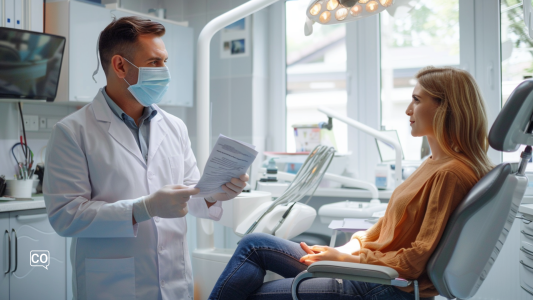
- Answer the questions about the image.
- Students can also prepare this exercise as a written text for the next class.
Example phrases:
|
Ich benötige, dass der Assistent die Wurzelzangen, den Elevator und den chirurgischen Bohrer für den Turbinenhandstück vorbereitet. I need the assistant to prepare the root forceps, the elevator, and the surgical bur for the turbine. |
|
Ich werde das Betäubungsmittel sehr langsam spritzen, keine Sorge – Sie werden nur einen kleinen Stich spüren. I’m going to inject the anesthesia very slowly, don’t worry — you will only feel a small prick. |
|
Jetzt werde ich den Zahn lockern; Sie werden einen gewissen Druck spüren, aber keinen Schmerz. Die Betäubung nimmt den Schmerz weg, nicht das Gefühl des Drucks. Now I’m going to loosen the tooth; you’ll feel a bit of pressure, but no pain. The anesthesia removes the pain, not the feeling of pressure. |
|
Sie könnten ein kleines "Knacken" hören, machen Sie sich keine Sorgen, das bedeutet nur, dass die Wurzel gebrochen ist, was sehr häufig vorkommt. You may hear a little “crack,” don’t worry, that just means the root has fractured, which is very common. |
|
Wenn Sie während der Extraktion Schmerzen verspüren, heben Sie Ihre linke Hand, und ich werde die Anästhesie sofort verstärken. If you feel any pain during the extraction, raise your left hand and I’ll reinforce the anesthesia immediately. |
|
Spülen Sie heute den Mund nicht aus und spucken Sie das Blut nicht aus. Legen Sie ein Mulltupfer auf die Wunde und beißen Sie fest für 30 Minuten, um die Blutung zu stoppen. Today, you must not rinse your mouth or spit out the blood. Place a gauze pad and bite down firmly for 30 minutes to stop the bleeding. |
| ... |