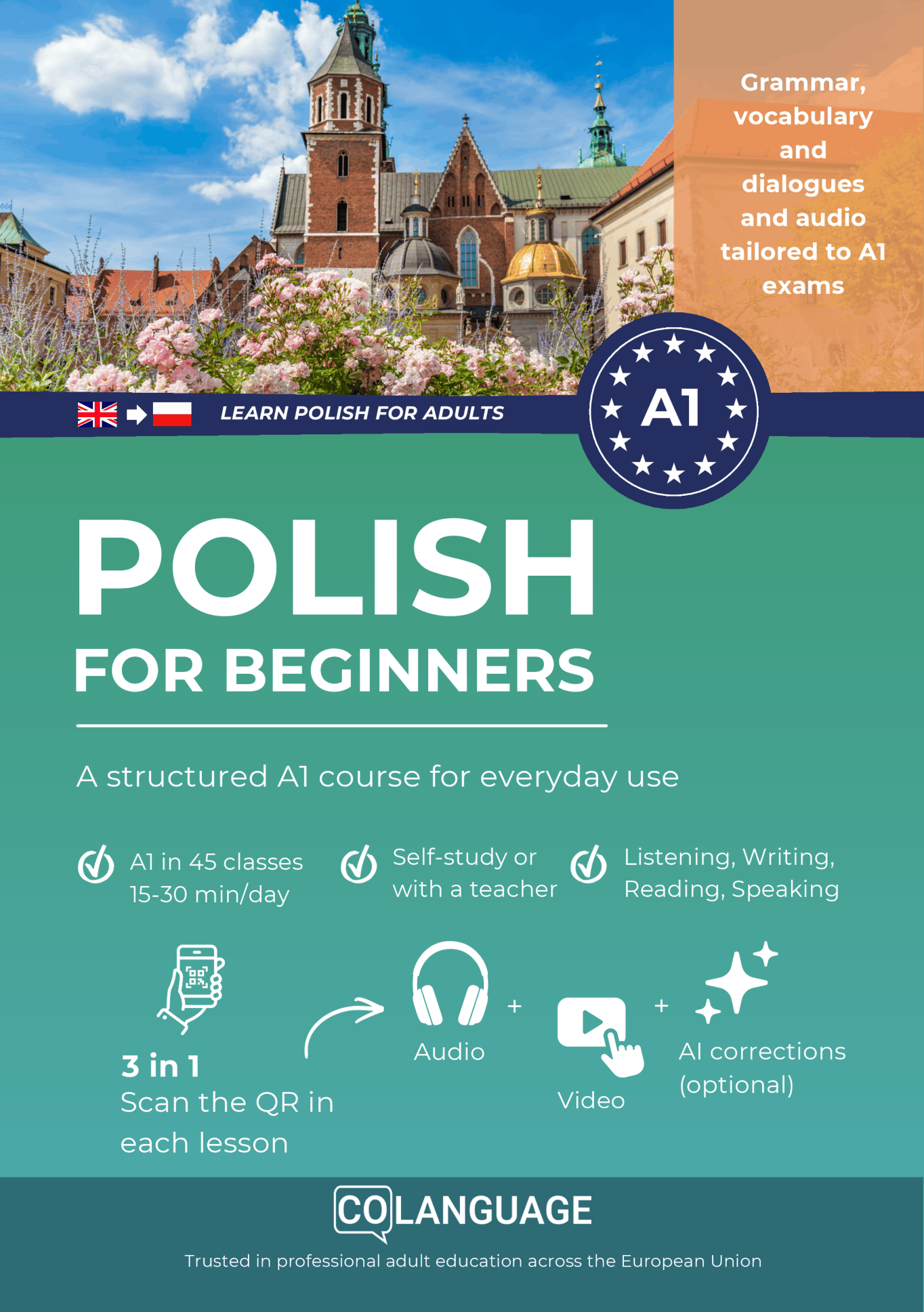
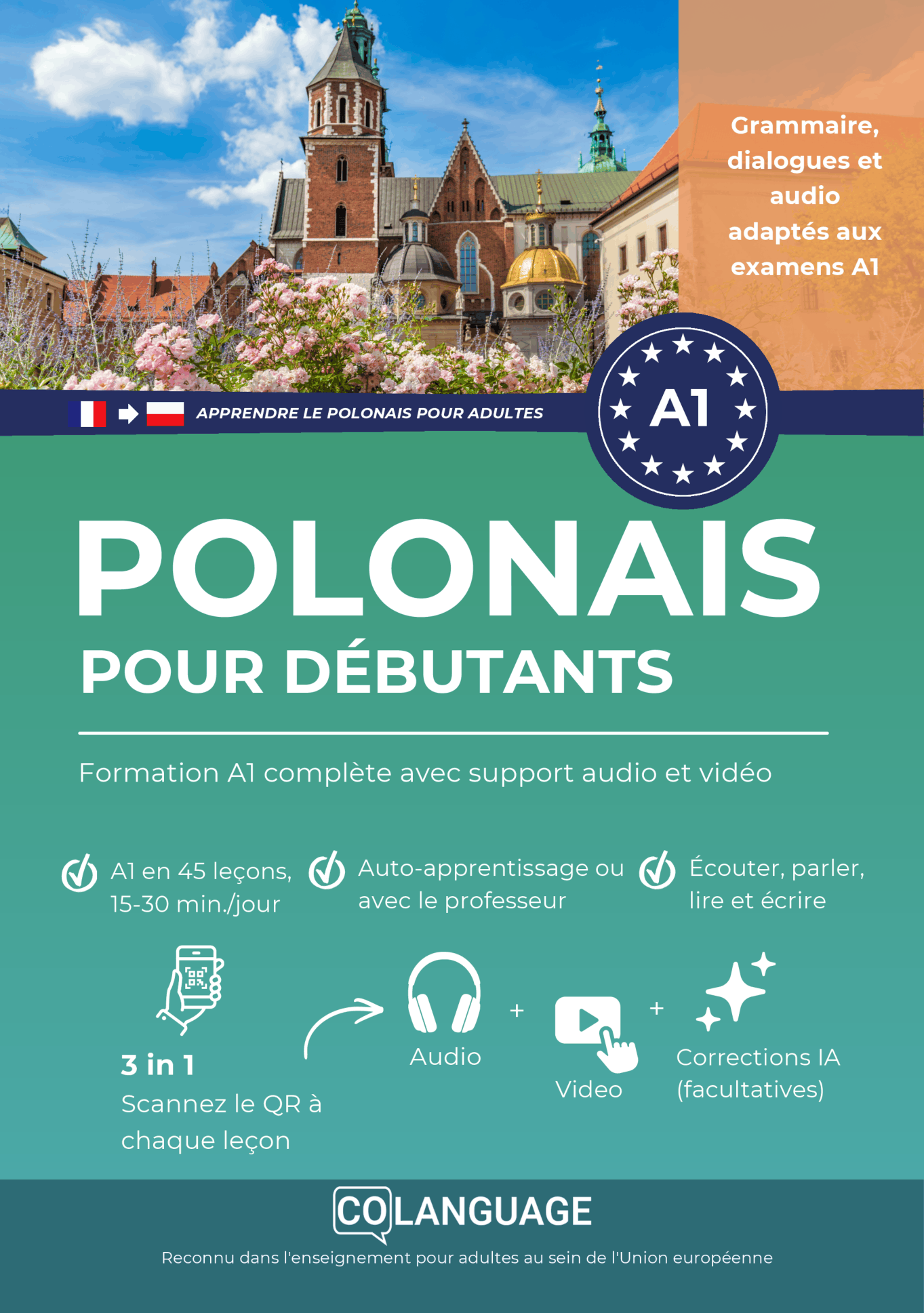
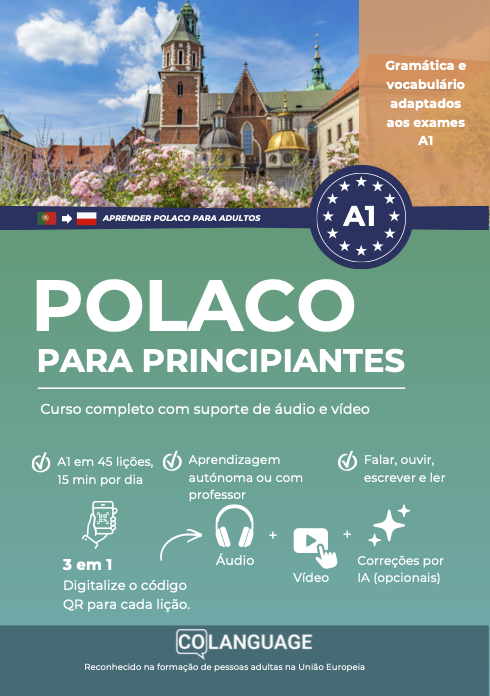
Polish A1 (beginner)

  • Joanna O.
  • Demi G.
  • Tomasz Adam K.
  • Elizabeta A.
120+ teachers!

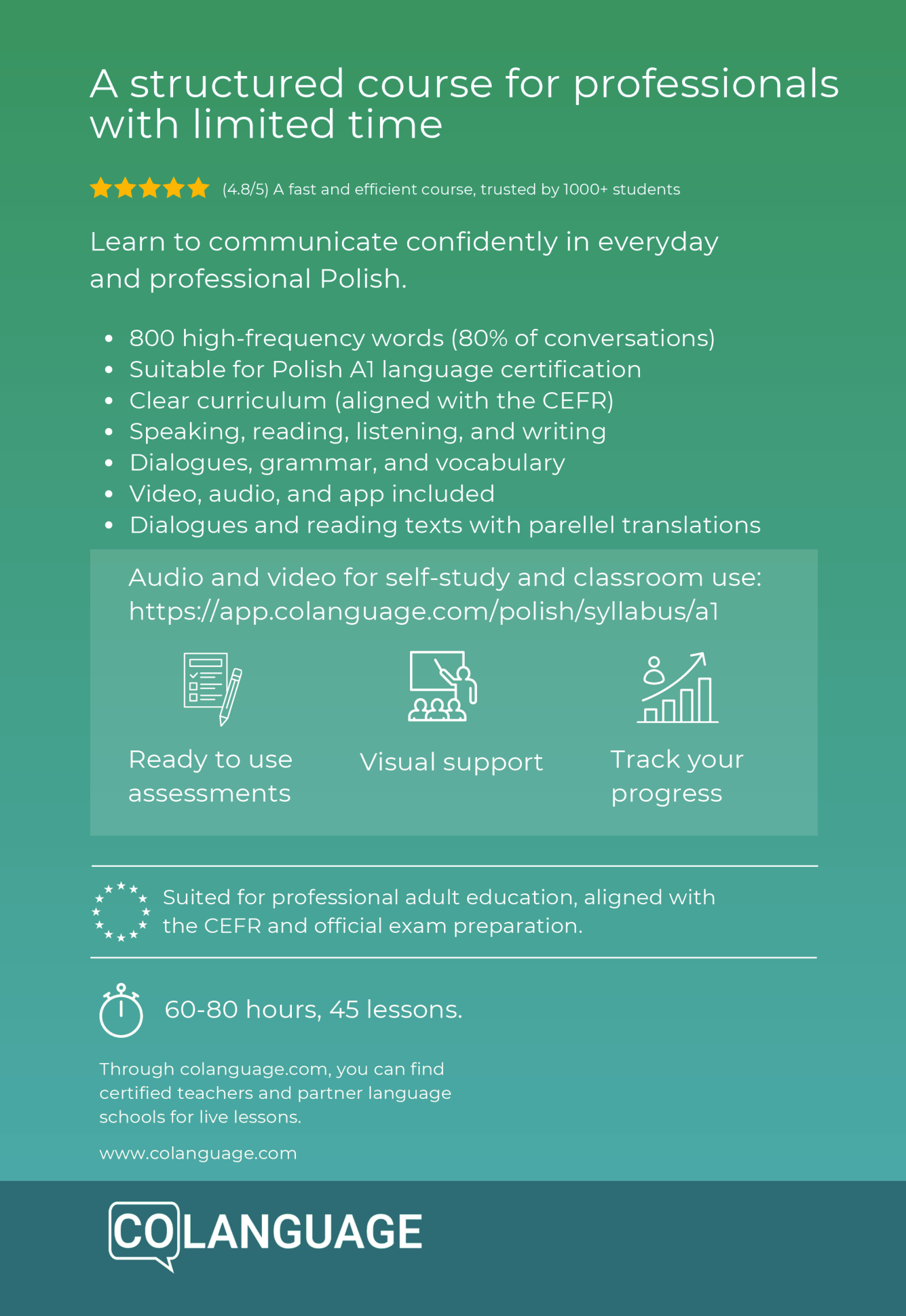
45 lessons
3 months (or faster!)
Suited for Państwowe Egzaminy Certyfikatowe z Języka Polskiego preparation
26 videos
  • Fast progress
  • Flexible class schedule
  • Online portal and PDF downloads
  • Real and immersive content.

A1.1 - Pozdrowienia i pożegnania (Greetings and Farewells)

  • Basic greetings and farewells.
  • Starting and ending a conversation.
  • Useful phrases to use during class (asking for clarification, repetition, etc.).
  • Personal pronouns: ja, ty on, ona...

A1.2 - Podawanie swojego imienia (Telling your name)

  • Tell your name and ask for the name of somebody
  • Titles and ways of addressing people. (Mister, miss,...)
  • Introduce yourself
  • Polish alphabet
  • Pronunciation, intonation and stress in the Polish language

A1.3 - Skąd jesteś? (Where are you from?)

  • Ask somebody where they are from
  • Say your nationality
  • Number and grammatical gender: dziecko, dzieci...
  • Nominative singular of nouns and adjectives kto? co? jaki? jaka? jakie?
  • Introduction to cases: kto? co? kogo? komu?

A1.4 - Liczby i liczenie (Numbers and counting)

  • Learn to count
  • Numbers from 1-100
  • Cardinal numbers from 20 to 99
  • Cardinal numbers: hundreds, thousands, millions
  • Cardinal numbers from 11 to 20

A1.5 - Rodzina (Family)

  • Introduce and tell about your family.
  • Ask someone about their family. (size, structure,...)
  • Possessive pronouns: mój, moja, moje...
  • Nouns in the accusative: kogo? co?

A1.6 - Podawanie wieku (Saying your age)

  • Asking somebody's age
  • Say how old you are and when your birthday is
  • Forms used when expressing age: rok, lata, lat
  • Interrogative words who? what? where? when? how much?

A1.7 - Zawody i studia (Professions and studies)

  • Describe your profession
  • Ask somebody's profession
  • Talk about studies
  • Feminine forms: teacher (female), actress...
  • Nouns in the instrumental: kim? czym?

A1.8 - Adres i dane kontaktowe (Address and contact details)

  • Asking for and giving contact details.
  • Tell and ask for addresses.
  • Conjugation of verbs in the present tense: pracuję, mówisz, pyta
  • Nouns in the locative case: komu? czemu?

A1.9 - Dni tygodnia i części dnia (Days of the week and parts of the day)

  • Learn the parts of the day.
  • Learn the names of the 7 days of the week
  • Describe your weekly activities.
  • Prepositions of time: za, w, przez, od, o

A1.10 - Pogoda (The weather)

  • Talk about the weather
  • Basic weather vocabulary
  • Forms used when expressing temperature "stopnie"
  • Adjectives and adverbs of weather: słonecznie, deszczowy...

A1.11 - Liczebniki porządkowe (Ordinal numbers)

  • Learn the ordinal numbers.
  • Ordinal numbers 11-24

A1.12 - Pory roku, miesiące i części roku (Seasons, months and parts of the year)

  • Learn the seasons and months.
  • Describe the weather in each season and month.
  • Advanced: tell what you do in what month of the year.
  • Future tense – the form będzie

A1.13 - Nauka odczytywania godziny i czytania zegara (Telling the time and reading the clock)

  • Ask and tell the time
  • Read the clock
  • Telling the time and reading the clock

A1.14 - Daty i święta kalendarzowe (Calendar dates and holidays)

  • The basic dates and holidays
  • Giving the date

A1.15 - Codzienne jedzenie (Daily food)

  • Name the food that we consume daily.
  • Tell what you eat and drink.
  • Conjunctions: and, or, but, because

A1.16 - Codzienne rutyny (Daily routines)

  • Talk about your daily routine.
  • Talk about habits.
  • Reflexive verbs: myję się, ubieram się...

A1.17 - Gotowanie i pieczenie (Cooking and baking)

  • Basic ingredients for cooking
  • Expressing obligations
  • Expressing necessity using "trzeba"

A1.18 - Pytanie o rzeczy (Asking things)

  • Ask and answer questions.
  • Learn the question words.
  • Interrogative pronouns skąd? dokąd? jak? dlaczego?...
  • Asking questions - the particle "czy"

A1.19 - Ceny i pieniądze (Prices and money)

  • Talk about money, currencies and payment methods.
  • Ask for and say the price in a shop.
  • Adverbs of quantity: mało, dużo, trochę...
  • Ways of stating prices: 10 złoty, 99 groszy

A1.20 - Zakupy spożywcze (Grocery shopping)

  • Write a grocery list for daily food and drinks.
  • Ask a shop assistant about a product in the supermarket.
  • Conjugation of verbs ending in -ować

A1.21 - W sklepie odzieżowym (At the clothing shop)

  • Describe everyday clothing.
  • Ask for availability in a clothing shop.
  • Ask for your size.
  • Modal verbs: mogę, muszę, chcę, umiem...

A1.22 - Części ciała (Body parts)

  • Get to know the basic body parts.
  • Basic phrases to describe your health.
  • Adverbs of manner: dobrze, źle, szybko, cicho...

A1.23 - Wygląd zewnętrzny (Physical appearance)

  • Describe people's physical appearance
  • Use adjectives to describe people.
  • nominative plural: ładne dziewczyny

A1.24 - Kolory (Colours)

  • Describe the colours of common objects.
  • Likes and dislikes: (nie) lubię, (nie) podoba mi się

A1.25 - Emocje i uczucia (Emotions and feelings)

  • Express your basic emotions.
  • Describe the emotions of others.
  • Demonstrative pronouns: ten, ta, to...

A1.26 - Zmysły i postrzeganie (Senses and perceiving)

  • Describe taste, smell, sight, sound and touch
  • Compare things
  • Degree adverbs: nie, bardzo, za, trochę

A1.27 - Kształty i formy (Shapes and forms)

  • Describe forms and shapes.
  • Describe basic objects.
  • Express preferences.
  • Comparisons: tak … jak, bardziej … niż, mniej … niż

A1.28 - Charakter i osobowość (Character and personality)

  • Learn to describe the character of people.
  • Talk about personalities.
  • The comparative degree of the adjective: dobry → lepszy

A1.29 - Stany fizyczne i odczucia (Physical states and sensations)

  • Express what you need.
  • Tell how your body feels.
  • The superlative degree of the adjective: dobry → lepszy → najlepszy

A1.30 - Choroba i ból (Sickness and pain)

  • Express sickness and pain.
  • Express your medical condition at the doctor's office.
  • Nouns in the genitive case: kogo? czego?
  • Expressing pain and symptoms: boli mnie głowa, mam katar

A1.31 - Nasz dom (Our house)

  • Describe all the rooms and floors of a house.
  • Understand a house rental or sales ad.
  • Forms used when expressing area: metry kwadratowe...
  • Adverbial pronouns indicating place: tu, tam, tutaj...

A1.32 - Meble (Furniture)

  • Describe the furniture in your house.
  • Prepositions of place: na stole, pod łóżkiem

A1.33 - Zastawa stołowa (Tableware)

  • Setting up the table to receive guests.
  • Giving objects: Proszę, podaj mi łyżkę

A1.34 - Sprzęt gospodarstwa domowego (Household appliances)

  • Learn the names of common household and electrical appliances.
  • Daily situations with common household devices.
  • Negations with the genitive: nie ma okna, nie lubię kawy

A1.35 - Mieszkalnictwo i zakwaterowanie (Housing and accommodation)

  • Learn the different types of accommodations.
  • Contact a landlord or agency to rent a house.
  • Prepositions of location and movement: do domu, obok parku

A1.36 - Rośliny doniczkowe i ogrodowe (Houseplants and garden plants)

  • Learn the names of common plants and flowers in the house and in the garden.
  • Talk about plant care and routines at your home or office.
  • Connectors: dlatego że, potem, też, też nie

A1.37 - Twoje zwierzęta (Your pets)

  • Learn the basic animals (pets).
  • Describe the routines, daily care and food of your pet.
  • Instrumental plural: z kochanymi psami

A1.38 - Usługi codzienne (Everyday services)

  • Describe the location of services on a map.
  • Ask for the opening hours of a certain service.
  • Past tense of imperfective verbs: pracowałem, kupiłeś, robił

A1.39 - Zamawianie jedzenia i jedzenie na mieście (Ordering food and dining out)

  • Ask food from the menu.
  • Reserve a table in a restaurant.
  • The conditional mood as a polite form: chciałbym, chciałabym

A1.40 - Sport i ćwiczenia (Sports and exercise)

  • Learn the sports
  • Talk about the sports you practice
  • Adverbs of frequency: zawsze, nigdy, czasami

A1.41 - Opis hobby (Describing hobbies)

  • Talk about your hobbies
  • Describe activities that you enjoy
  • Adverbs of time: teraz, wcześniej, później, potem

A1.42 - Transport (Transportation)

  • Describe the different types of transportation.
  • Buy a transport ticket.
  • Describe transportation between places.
  • Prepositions of place and transport: z, do, przez, w stronę...

A1.43 - Pytanie o i udzielanie wskazówek (Asking for and giving directions)

  • Ask for directions in a city
  • Giving directions to a stranger
  • Ask for the existence of a building or service.
  • Giving directions and locating places: prosto, w prawo, po lewej...

A1.44 - Piątkowy wieczór na mieście (Friday night out)

  • Make plans with your friends for the Friday evening.
  • Invite somebody for an event.
  • Expressing preferences: woleć, uwielbiać, nienawidzić

A1.45 - Muzyka i sztuka (Music and art)

  • Talk about culture events in the city.
  • Go to the museum, an exposition, musical,...
  • Future tense of imperfective verbs: będę czekać, będzie pracował...