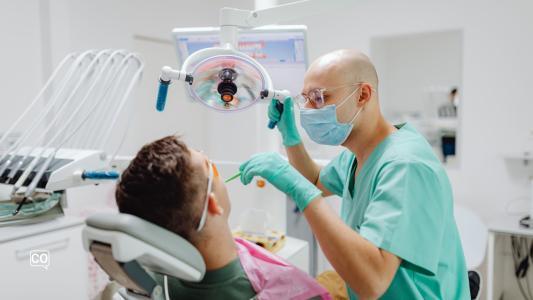
Dentistry 3.1 - Routine check-up
Routinecontrole
Exercise 1: Language immersion
Instruction: Recognize the indicated vocabulary in the video.
| Word | Translation |
|---|---|
| een afspraak hebben | to have an appointment |
| de hygiënerichtlijnen | the hygiene guidelines |
| het schone instrumentarium | the clean instruments |
| u mag gaan zitten | please have a seat |
| de gezondheidssituatie | the health situation |
| zich comfortabel voelen | to feel comfortable |
| de röntgentechnieken | the X‑ray techniques |
| de overzichtsfoto | the overview image |
| de uitgebreide opname | the detailed image |
| de schedel fotograferen | to photograph the skull |
| de behandelkamer | the treatment room |
| ondersteunen | to support |
| een nieuwe afspraak maken | to make a new appointment |
| Welkom in onze tandartspraktijk. | (Welcome to our dental practice.) |
| We zorgen ervoor dat alles zo schoon mogelijk is volgens de hygiënerichtlijnen. | (We ensure everything is as clean as possible in accordance with the hygiene guidelines.) |
| Onze assistentes reinigen en steriliseren elke dag al het instrumentarium in een aparte sterilisatieruimte. | (Our assistants clean and sterilize all instruments every day in a separate sterilization room.) |
| Voor iedere patiënt gebruiken we een nieuwe, schone instrumentenset, zodat we veilig kunnen werken. | (For each patient we use a new, clean set of instruments so we can work safely.) |
| Tijdens uw bezoek doen we ons best om u zich zo comfortabel mogelijk te laten voelen in de behandelkamer. | (During your visit we do our best to make you feel as comfortable as possible in the treatment room.) |
| We beschikken over geavanceerde digitale röntgenapparatuur, van eenvoudige tandfoto’s tot gedetailleerde opnames van de schedel. | (We have advanced digital X‑ray equipment, from simple dental images to detailed scans of the skull.) |
| Met deze röntgentechnieken kunnen we zowel een overzichtsfoto als een meer uitgebreide opname maken wanneer dat nodig is. | (With these X‑ray techniques we can take both an overview image and a more detailed image when necessary.) |
| Onze assistentes hebben een digitaal oproepsysteem om in contact te blijven met de behandelkamers en u snel te ondersteunen. | (Our assistants use a digital paging system to stay in contact with the treatment rooms and to assist you quickly.) |
| Na de behandeling kunt u bij de receptie eenvoudig een nieuwe afspraak maken. | (After the treatment you can easily make a new appointment at the reception desk.) |
| We hopen dat u tevreden de praktijk verlaat. Tot ziens. | (We hope you leave the practice satisfied. Goodbye.) |
Comprehension questions:
-
Waarom is er in de praktijk een aparte sterilisatieruimte voor het instrumentarium?
(Why is there a separate sterilization room for the instruments in the practice?)
-
Welke soorten röntgenopnames kunnen in de praktijk worden gemaakt en waarvoor zijn die belangrijk tijdens een eerste consult?
(What types of X‑ray images can be taken in the practice and why are they important during an initial consultation?)
-
Hoe wordt er in de praktijk gezorgd dat u zich comfortabel en goed ondersteund voelt tijdens de behandeling?
(How does the practice ensure you feel comfortable and well supported during the treatment?)
Exercise 2: Dialogue
Instruction: Read the dialogue and answer the questions.
Eerste bezoek aan de tandarts
| 1. | De tandarts: | Hallo, welkom in de kliniek. Is dit uw eerste bezoek? | (Hello, welcome to the clinic. Is this your first visit?) |
| 2. | De patiënt: | Ja, dokter. Ik ben een beetje gestrest, ik houd niet zo van de tandarts. | (Yes, doctor. I'm a bit nervous — I don't really like going to the dentist.) |
| 3. | De tandarts: | Heeft u de medische vragenlijst ingevuld? | (Have you completed the medical questionnaire?) |
| 4. | De patiënt: | Ja, dat heb ik net in de wachtkamer gedaan. | (Yes, I just filled it out in the waiting room.) |
| 5. | De tandarts: | Heel goed. We gaan uw mond onderzoeken met een spiegel, een sonde en een pincet. | (Very good. We'll examine your mouth with a mirror, a probe and a pair of tweezers.) |
| 6. | De patiënt: | Doet dat pijn? Bij mijn vorige tandarts deed het pijn. | (Will that hurt? At my previous dentist it was painful.) |
| 7. | De tandarts: | Nee, helemaal niet. Ik ga alleen even in uw mond kijken. Daarna leg ik uit wat ik zie. | (No, not at all. I'm only going to take a look inside your mouth. After that I'll explain what I see.) |
| 8. | De patiënt: | Oké, dat is goed. | (Okay, that sounds fine.) |
| 9. | De tandarts: | Daarna maken we een behandelplan en de assistente zal de kosten aan u uitleggen. | (Afterwards we'll make a treatment plan and the assistant will explain the costs to you.) |
| 10. | De patiënt: | Kan ik dan bij haar een volgende afspraak maken? | (Can I make the next appointment with her then?) |
| 11. | De tandarts: | Ja, dat kan zeker. Nu beginnen we met de routinecontrole. | (Yes, certainly. Now we'll start with the routine check-up.) |
1. Lees de dialoog. Wie is er gestrest bij dit eerste bezoek?
(Read the dialogue. Who is nervous at this first visit?)2. Wat heeft de patiënt net in de wachtkamer gedaan?
(What did the patient just do in the waiting room?)Exercise 3: Open conversation questions
Instruction: Answer the questions and correct with your teacher.
-
U bent tandarts in een nieuwe praktijk. Hoe verwelkomt u een volwassen patiënt die voor het eerst komt en een beetje bang is? Zeg dit in 1–2 zinnen.
You are a dentist at a new practice. How do you welcome an adult patient who is visiting for the first time and feels a little anxious? Say this in 1–2 sentences.
__________________________________________________________________________________________________________
-
Wat legt u kort uit aan de patiënt voordat u met de mondspiegel en sonde in de mond gaat kijken? Noem in 1–2 zinnen wat u gaat doen.
What do you briefly explain to the patient before you look into their mouth with a mouth mirror and probe? In 1–2 sentences, say what you are going to do.
__________________________________________________________________________________________________________
-
De patiënt vraagt: “Gaat het pijn doen?” Hoe reageert u rustig en duidelijk in 1–2 zinnen?
The patient asks, “Will it hurt?” How do you answer calmly and clearly in 1–2 sentences?
__________________________________________________________________________________________________________
-
Aan het einde van de eerste controle: wat zegt u in 1–2 zinnen over het behandelplan en de volgende afspraak?
At the end of the first check-up: what do you say in 1–2 sentences about the treatment plan and the next appointment?
__________________________________________________________________________________________________________
Practise this dialogue with a real teacher!
This dialogue is part of our learning materials. During our conversation classes, you practise the situations with a teacher and other students.
- Implements CEFR, DELE exam and Cervantes guidelines
- Supported by the university of Siegen