A1.15 - Daily food - Exercises
Get your bookExercise 1: Match a word
Instruction: Match each beginning with its correct ending.
Fetching your corrections... Please don't close this page yet.
Exercise 2:
Exam preparation 
Instruction: Read the text, fill in the gaps with the missing words, and answer the questions below
Fetching your corrections... Please don't close this page yet.
Cantine d'entreprise - Menu du jour
Cantine - Menu du jour (France)
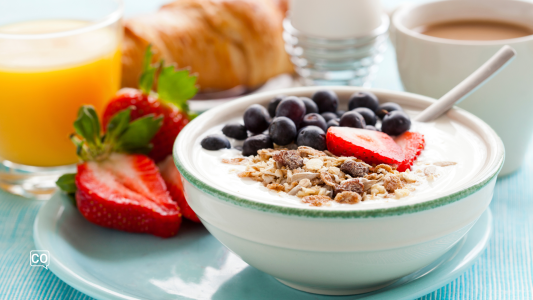
Petit-déjeuner: café, eau et avec . Déjeuner: salade, avec riz ou pâtes, et un fruit. Dîner à emporter: poisson et . Allergies: et fromage possibles dans certains plats. Pour boire, demandez de ou du lait au comptoir.Cafeteria - Daily Menu (France)
Breakfast: coffee, water and bread with butter. Lunch: salad, chicken with rice or pasta, and a piece of fruit. Dinner to take away: fish and potatoes. Allergies: egg and cheese may be present in some dishes. To drink, ask for water or milk at the counter.
Exercise 3:
Listen and answer the questions
Instruction: Listen to the audio and answer the questions.
Fetching your corrections... Please don't close this page yet.
1. Qu'est-ce qu'elle prend au petit-déjeuner ?
2. Combien coûte le poulet aujourd'hui ?
Exercise 4: Verb conjugations
Instruction: Choose the correct solution
Fetching your corrections... Please don't close this page yet.
1. Au petit-déjeuner, je ___ mon café et je mange du pain.
(At breakfast, I ___ my coffee and eat some bread.)2. Au déjeuner, tu ___ du poulet avec du riz.
(At lunch, you ___ chicken with rice.)3. À la cantine, nous ___ la salade avant les pâtes.
(In the cafeteria, we ___ the salad before the pasta.)
Exercise 5:
Dialogue comprehension
Instruction: Practice the conversation with your teacher or fellow students.
Fetching your corrections... Please don't close this page yet.
Petit-déjeuner au bureau
Claire (collègue): Show Salut Marc, tu prends quoi au petit-déjeuner ?
(Hi Marc — what do you have for breakfast?)
Marc (vous): Show Je bois du lait et un café, et je mange une pomme.
(I have milk and a coffee, and I eat an apple.)
Claire (collègue): Show Moi, je mange du pain avec du beurre et du fromage.
(I have bread with butter and cheese.)
Marc (vous): Show D’accord. À midi, je prendrai une salade.
(Okay. At lunchtime I'll have a salad.)
Open questions:
1. Qu’est-ce que Marc boit au petit-déjeuner ?
What does Marc drink for breakfast?
Courses après le travail
Vendeuse: Show Bonjour madame, je peux vous aider ?
(Hello, ma'am — can I help you?)
Sophie (cliente): Show Oui, je voudrais du poulet et des pommes de terre pour le dîner.
(Yes, I'd like some chicken and potatoes for dinner.)
Vendeuse: Show Très bien. Et pour le déjeuner, du riz ou des pâtes ?
(Very good. And for lunch, rice or pasta?)
Sophie (cliente): Show Des pâtes, et une bouteille d'eau, s'il vous plaît.
(Pasta, and a bottle of water, please.)
Open questions:
1. Quels aliments Sophie achète pour le dîner ?
What foods does Sophie buy for dinner?
Exercise 6: Respond to the situation
Instruction: Practice in pairs or with your teacher.
Fetching your corrections... Please don't close this page yet.
1. Vous êtes à la boulangerie. Le vendeur vous demande ce que vous voulez pour ce midi. Répondez simplement. (Utilisez : le pain, s'il vous plaît, je prends...)
(You are at the bakery. The shopkeeper asks what you want for lunch. Answer simply. (Use: le pain, s'il vous plaît, je prends...))Je prends
(Je prends ...)Example:
Bonjour, je prends du pain, s'il vous plaît.
(Hello, I'll take some bread, please.)2. Au travail, un collègue vous demande ce que vous buvez le matin. Répondez en une phrase. (Utilisez : le café, je bois..., le matin)
(At work, a colleague asks what you drink in the morning. Answer in one sentence. (Use: le café, je bois..., le matin))Le matin, je bois
(Le matin, je bois ...)Example:
Le matin, je bois un café.
(In the morning I drink coffee.)Exercise 7: Writing correspondence
Instruction: Write a reply to the following message appropriate to the situation
Fetching your corrections... Please don't close this page yet.
Salut ! Je suis au supermarché. Pour ce soir, tu préfères poulet ou poisson ?
Et pour demain matin, on prend quoi pour le petit-déjeuner ? Il reste un peu de pain à la maison, mais on n’a plus de beurre ni de fromage. Tu veux aussi des œufs ou une salade ? Dis-moi vite 😊
- Camille
Hi! I'm at the supermarket. For tonight, do you prefer chicken or fish?
And for tomorrow morning, what should we have for breakfast? There's a little bread left at home, but we don't have any butter or cheese. Do you also want eggs or a salad? Tell me quickly 😊
- Camille
Useful phrases:
-
Je préfère… avec…
(I prefer… with…)
-
Pour le petit-déjeuner, je prends…
(For breakfast, I'll have…)
-
Tu peux acheter… s'il te plaît ?
(Can you buy… please?)
Pour demain matin, je prends du pain et un café. Tu peux acheter du beurre et du fromage, s'il te plaît ? Oui, prends aussi une boîte d'œufs. Merci !
Hi Camille! For tonight, I prefer chicken with pasta. I'll drink water.
For tomorrow morning, I'll have bread and a coffee. Can you buy butter and cheese, please? Also grab a carton of eggs. Thanks!
Learn French for beginners - A practical A1 course with audio
ISBN 979-13-88253-31-7
This app supports this book.