


A1.15 - Daily food - Exercises
Get your bookExercise 1: Match a word
Instruction: Match each beginning with its correct ending.
Fetching your corrections... Please don't close this page yet.
Exercise 2:
Exam preparation 
Instruction: Read the text, fill in the gaps with the missing words, and answer the questions below
Fetching your corrections... Please don't close this page yet.
Correo del comedor de la oficina
Hola equipo:
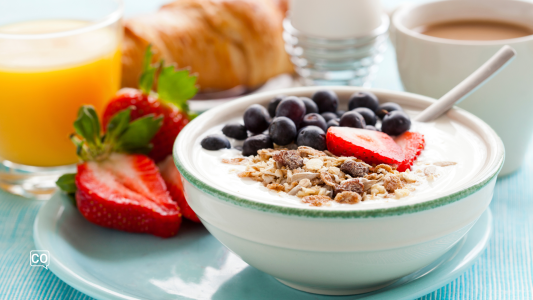
Desde hoy hay un nuevo menú en el comedor de la oficina. Para el desayuno ofrecemos , con , y . También hay , , y . Para la comida proponemos un plato sencillo: con pan y una pequeña ensalada. El menú es básico, con poca sal, y es adecuado para cada día. Si quieres algo dulce, puedes traer tu propio postre de casa. Puedes comer en el comedor o en tu mesa de trabajo.Hello team:
Starting today there is a new menu in the office cafeteria. For breakfast we offer bread, toast with cheese, an apple and an orange. We also have milk, water, coffee and tea. For lunch we offer a simple dish: eggs with bread and a small salad. The menu is basic, lightly salted, and suitable to eat every day. If you want something sweet, you can bring your own dessert from home. You can eat in the cafeteria or at your desk.
Exercise 3:
Listen and answer the questions
Instruction: Listen to the audio and answer the questions.
Fetching your corrections... Please don't close this page yet.
1. ¿Qué desayuno típico describe la persona?
2. ¿Qué dice la persona sobre su comida en la oficina?
Exercise 4: Verb conjugations
Instruction: Choose the correct solution
Fetching your corrections... Please don't close this page yet.
1. Por la mañana yo ___ café y como una tostada con queso.
(In the morning I ___ coffee and eat a slice of toast with cheese.)2. En el trabajo nosotros ___ una manzana o un yogur en la pausa.
(At work we ___ an apple or a yogurt during the break.)3. En casa mis compañeros ___ agua e infusiones, pero yo solo bebo té.
(At home my coworkers ___ water and herbal tea, but I only drink tea.)
Exercise 5:
Dialogue comprehension
Instruction: Practice the conversation with your teacher or fellow students.
Fetching your corrections... Please don't close this page yet.
Desayuno en la cafetería del trabajo
Compañera Marta: Show Hola, ¿qué vas a desayunar hoy en la cafetería?
(Hi — what are you having for breakfast today in the cafeteria?)
Tú: Show Hola, hoy voy a tomar una tostada con queso y una manzana.
(Hi — today I'm having a toast with cheese and an apple.)
Compañera Marta: Show Qué bien, yo bebo café con leche y como pan con queso; es mi desayuno favorito.
(That's nice. I drink coffee with milk and eat bread with cheese; it's my favorite breakfast.)
Tú: Show Yo no tomo café, prefiero agua o té por la mañana.
(I don't drink coffee — I prefer water or tea in the morning.)
Open questions:
1. ¿Qué sueles comer normalmente para desayunar?
What do you normally eat for breakfast?
Hacer la lista de la compra semanal
Pareja Ana: Show Esta semana quiero comer más sano, ¿qué compramos?
(This week I want to eat healthier — what should we buy?)
Tú: Show Compremos manzanas, naranjas, pan y queso.
(Let's buy apples, oranges, bread, and cheese.)
Pareja Ana: Show Vale, ¿y para beber? ¿Agua, leche o café?
(Okay — and to drink? Water, milk, or coffee?)
Tú: Show Agua y leche, el café no es mi favorito.
(Water and milk. Coffee isn't my favorite.)
Open questions:
1. ¿Qué alimentos quieres comprar esta semana?
What foods do you want to buy this week?
Exercise 6: Respond to the situation
Instruction: Practice in pairs or with your teacher.
Fetching your corrections... Please don't close this page yet.
1. Estás en el trabajo y una compañera te pregunta: «¿Qué desayunas cada día?» Explica de forma simple qué comes y bebes por la mañana. (Usa: la tostada, el café, comer)
(You are at work and a colleague asks you: «¿Qué desayunas cada día?» Explain simply what you eat and drink in the morning. (Use: la tostada, el café, comer))Por la mañana como
(In the morning I eat ...)Example:
Por la mañana como la tostada y bebo un café.
(In the morning I eat toast and drink a coffee.)2. Estás en una cafetería y el camarero te pregunta: «¿Qué quiere beber?» Di qué bebida quieres ahora. (Usa: el agua, el café, beber)
(You are in a café and the waiter asks you: «¿Qué quiere beber?» Say which drink you want now. (Use: el agua, el café, beber))Para beber quiero
(To drink I would like ...)Example:
Para beber quiero agua, por favor.
(To drink I would like water, please.)Exercise 7: Writing correspondence
Instruction: Write a reply to the following message appropriate to the situation
Fetching your corrections... Please don't close this page yet.
Hola,
mañana voy al supermercado. Quiero comprar cosas para el desayuno.
Yo tomo café y tostada con queso o mermelada. A veces bebo té.
¿Tú qué comes y qué bebes por la mañana? ¿Quieres pan, leche, huevos, manzanas o naranjas? Dime cuál es tu desayuno favorito.
Gracias,
Laura
Hi,
tomorrow I’m going to the supermarket. I want to buy things for breakfast.
I have coffee and toast with cheese or jam. Sometimes I drink tea.
What do you eat and what do you drink in the morning? Do you want bread, milk, eggs, apples or oranges? Tell me what your favourite breakfast is.
Thanks,
Laura
Useful phrases:
-
Para el desayuno yo como…
(For breakfast I eat…)
-
Normalmente bebo…
(I usually drink…)
-
Prefiero que compres…
(I’d prefer that you buy…)
Para el desayuno yo normalmente como pan con queso y a veces una tostada con mermelada. Normalmente bebo té, no tomo café. También me gusta la leche y como una manzana a veces.
Para mañana, por favor compra pan, queso y té. No hace falta comprar huevos ni naranjas.
Gracias,
[Tu nombre]
Hi Laura,
For breakfast I usually eat bread with cheese and sometimes toast with jam. I usually drink tea; I don’t drink coffee. I also like milk and sometimes have an apple.
For tomorrow, please buy bread, cheese and tea. There’s no need to buy eggs or oranges.
Thanks,
[Your name]
Learn Spanish for beginners: A structured A1 course for work and daily life
ISBN 979-13-88253-00-3
This app supports this book.