


A1.7 - Professions and studies - Exercises
Get your bookExercise 1: Reorder sentences
Instruction: Make correct sentences.
Fetching your corrections... Please don't close this page yet.
Show answersExercise 2: Match a word
Instruction: Match each beginning with its correct ending.
Fetching your corrections... Please don't close this page yet.
Exercise 3:
Listen and answer the questions 
Instruction: Listen to the audio and answer the questions.
Fetching your corrections... Please don't close this page yet.
1. ¿A qué se dedica Marta?
2. ¿Qué hace Luis ahora?
Exercise 4: Verb conjugations
Instruction: Choose the correct solution
Fetching your corrections... Please don't close this page yet.
1. ¿Dónde ___, en un hospital o en una oficina?
(Where do you ___, in a hospital or in an office?)2. ¿Qué ___ ahora, medicina o ingeniería?
(What are you ___ now, medicine or engineering?)3. ¿A qué ___, eres profesor o periodista?
(What do you ___ for a living — are you a teacher or a journalist?)
Exercise 5:
Dialogue comprehension
Instruction: Practice the conversation with your teacher or fellow students.
Fetching your corrections... Please don't close this page yet.
Conocer a un nuevo compañero
Compañero nuevo: Show Hola, soy Miguel. Soy ingeniero y empiezo a trabajar en esta oficina.
(Hi, I'm Miguel. I'm an engineer and I'm starting work at this office.)
Tú: Show Hola, encantada. Soy Ana, trabajo en el departamento de marketing.
(Hi, nice to meet you. I'm Ana — I work in the marketing department.)
Compañero nuevo: Show ¿Siempre has trabajado en marketing o estudiaste otra cosa?
(Have you always worked in marketing, or did you study something else?)
Tú: Show Estudié Economía en la universidad y ahora trabajo aquí.
(I studied Economics at university, and now I work here.)
Open questions:
1. ¿En qué trabajas?
What do you do for work?
Exercise 6: Respond to the situation
Instruction: Practice in pairs or with your teacher.
Fetching your corrections... Please don't close this page yet.
1. Estás en tu primer día en una empresa en Madrid. Conoces a una compañera en la cocina y ella te pregunta: «¿A qué te dedicas?». Responde y di también si te gusta tu trabajo. (Usa: el trabajo, dedicarse a, me gusta / no me gusta)
(It's your first day at a company in Madrid. You meet a colleague in the kitchen and she asks you: «¿A qué te dedicas?». Answer and also say whether you like your job. (Use: el trabajo, dedicarse a, me gusta / no me gusta))Mi trabajo es
(Mi trabajo es ...)Example:
Mi trabajo es como ingeniero en una oficina y me gusta mucho.
(Mi trabajo es de ingeniero en una oficina y me gusta mucho.)2. Conoces a otra persona en un curso de español. Le preguntas por su profesión. Haz una pregunta sencilla y clara. (Usa: el médico, el ingeniero, ¿a qué te dedicas?)
(You meet someone else in a Spanish class. Ask them about their profession. Make a simple, clear question. (Use: el médico, el ingeniero, ¿a qué te dedicas?))¿Tú eres ?
(¿Tú eres ...?)Example:
¿Tú eres médico o eres ingeniero?
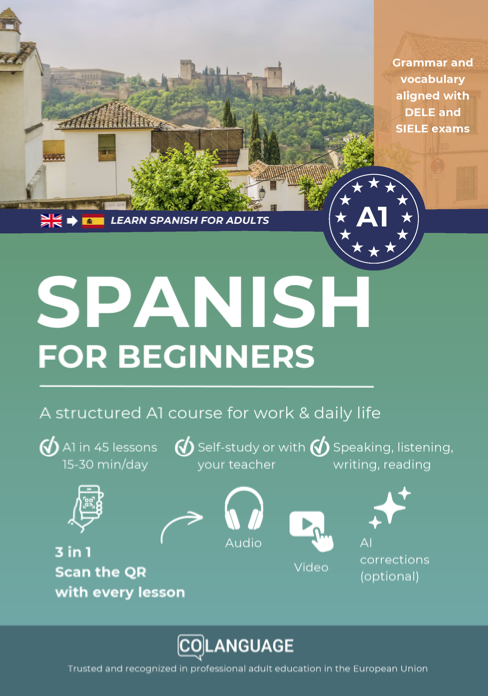
(¿Tú eres médico o eres ingeniero?)Learn Spanish for beginners: A structured A1 course for work and daily life
ISBN 979-13-88253-00-3
This app supports this book.