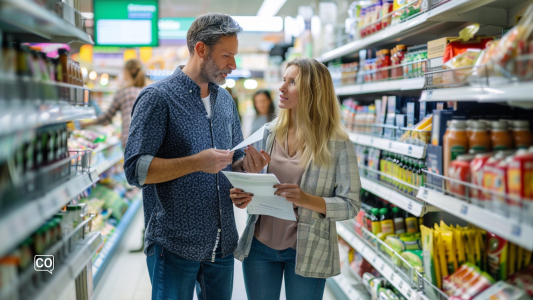
The shopping
Thorsten and Annika are in the supermarket with their shopping list and are trying to get everything as efficiently as possible through clear division of labour.
Exercise 1: Language immersion
Instruction: Watch the video and answer the related questions.
Fetching your corrections... Please don't close this page yet.
| Word | Translation |
|---|---|
| Die Gemüseabteilung | The vegetable section |
| Die Vitamine und die Ballaststoffe | The vitamins and the fiber |
| Das Obst und das Gemüse | The fruit and vegetables |
| Der Brokkoli‑Blumenkohl‑Mix | The broccoli–cauliflower mix |
| Der Spargel | The asparagus |
| Die Beeren | The berries |
| Die Bananen | The bananas |
1. Warum nimmt die Person grünes Gemüse?
(Why does the person take green vegetables?)2. Wie viel Obst und Gemüse isst die Person am Tag?
(How much fruit and vegetables does the person eat per day?)3. Welche Lebensmittel kauft die Person als Nächstes?
(Which foods does the person buy next?)4. Wofür kauft die Person Bananen?
(What does the person buy bananas for?)Exercise 2: Dialogue
Instruction: Read the dialogue and answer the questions.
Fetching your corrections... Please don't close this page yet.
Thorsten und Annika im Supermarkt: Mit der Einkaufsliste alles schnell finden
| 1. | Thorsten: | Womit fangen wir an? | (What should we start with?) |
| 2. | Annika: | Lass uns in der Gemüseabteilung anfangen. Ich nehme Paprika, Spargel und Tomaten. | (Let's start in the vegetable section. I'll take bell peppers, asparagus, and tomatoes.) |
| 3. | Thorsten: | Ich hole in der Zeit das Obst: Äpfel, Bananen und Himbeeren. Willst du noch etwas anderes? | (In the meantime, I'll get the fruit: apples, bananas, and raspberries. Do you want anything else?) |
| 4. | Annika: | Kannst du schauen, ob es schon Erdbeeren gibt? Die hatte ich schon ewig nicht mehr. | (Can you check whether there are strawberries yet? I haven't had those in ages.) |
| 5. | Thorsten: | Erdbeeren gibt es noch nicht. Die gibt es erst ab nächstem Monat. | (There aren't any strawberries yet. They'll only be available starting next month.) |
| 6. | Annika: | Schade. Was steht noch auf der Einkaufsliste? | (Too bad. What else is on the shopping list?) |
| 7. | Thorsten: | Viel mehr ist es eigentlich gar nicht: Nudeln, Reis und Klopapier. | (Actually, it isn't much more: pasta, rice, and toilet paper.) |
| 8. | Annika: | Kannst du Reis und Nudeln holen? Ich suche dann das Klopapier und gehe schon mal zur Kasse. | (Can you get rice and pasta? I'll look for the toilet paper and head to the checkout already.) |
| 9. | Thorsten: | Perfekt! | (Perfect!) |
1. Was holt Thorsten als Obst?
(What fruit does Thorsten get?)2. Warum kauft Annika keine Erdbeeren?
(Why doesn't Annika buy any strawberries?)Exercise 3: Use the website or the reading text
Instruction: You are new in Germany and go to ALDI Nord to buy fruit and vegetables.
Fetching your corrections... Please don't close this page yet.
Show/hide translationsTask: Öffnen Sie den Link und finden Sie die Angaben zu den Produkten.
URL: Aldi Nord
Use in your answer: Obst & Gemüse / frisch / Angebote / Mini-Rispentomaten / Tafeläpfel Braeburn / Einkaufsliste
Learn German for beginners - An A1 course for adults with little time
ISBN 979-13-88253-15-7
This app supports this book.