What goes into the cellar?
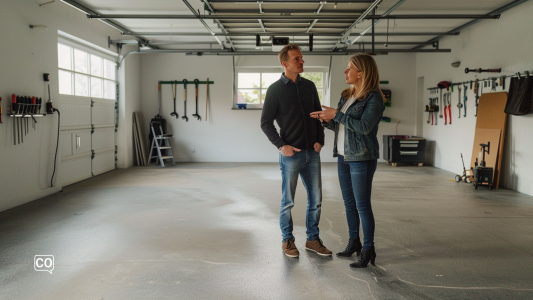
Get your bookBenedikt and Nathalie have realised their dream of owning a house and are planning how to lay out the rooms.
Exercise 1: Language immersion
Instruction: Watch the video and answer the related questions.
Fetching your corrections... Please don't close this page yet.
| Word | Translation |
|---|---|
| Die Waschmaschine | The washing machine |
| Das Bügeleisen | The iron |
| Die Heizung | The heating |
| Das Haushaltsgerät | The household appliance |
| Der Staubsauger | The vacuum cleaner |
| Die Zahnbürste | The toothbrush |
| Putzen | Cleaning |
1. Welche Geräte sollen seit Neuestem Informationen über die Nutzer sammeln?
(Which devices are supposed to collect information about users recently?)2. Was wollen die Menschen mit den neuen Haushaltsgeräten prüfen?
(What do people want to check with the new household appliances?)3. Warum bleibt kaum Zeit zum Putzen?
(Why is there hardly any time left for cleaning?)4. Welche Idee hat Sascha am Ende?
(What idea does Sascha have at the end?)Exercise 2: Dialogue
Instruction: Read the dialogue and answer the questions.
Fetching your corrections... Please don't close this page yet.
Benedikt und Nathalie planen die Räume im Haus
| 1. | Benedikt: | Was hältst du davon, wenn wir im Keller einen Raum für die Wäsche einrichten? | (What do you think about setting up a room for the laundry in the basement?) |
| 2. | Nathalie: | Und was willst du dann da hineinstellen? | (And what do you want to put in there then?) |
| 3. | Benedikt: | Auf jeden Fall die Waschmaschine. | (Definitely the washing machine.) |
| 4. | Nathalie: | Das finde ich eine gute Idee. Was sollen wir noch hineinstellen? | (I think that's a good idea. What else should we put in there?) |
| 5. | Benedikt: | Wir könnten noch einen Kühlschrank und eine Tiefkühltruhe hineinstellen. | (We could also put a refrigerator and a chest freezer in there.) |
| 6. | Nathalie: | Das finde ich super. | (I think that's great.) |
| 7. | Benedikt: | Im Winter ist es im Keller aber ziemlich kalt. | (But in winter it's pretty cold in the basement.) |
| 8. | Nathalie: | Dann brauchen wir auf jeden Fall auch eine Heizung im Keller. | (Then we definitely also need a heater in the basement.) |
| 9. | Benedikt: | Sagst du das dem Techniker am Montag? | (Will you tell the technician that on Monday?) |
| 10. | Nathalie: | Ja, das mache ich. | (Yes, I'll do that.) |
1. Welche Geräte wollen Benedikt und Nathalie in den Keller stellen?
(Which appliances do Benedikt and Nathalie want to put in the basement?)2. Warum brauchen sie eine Heizung im Keller?
(Why do they need a heater in the basement?)Learn German for beginners - An A1 course for adults with little time
ISBN 979-13-88253-15-7
This app supports this book.