

A1.15 - Daily food - Exercises
Get your bookExercise 1: Match a word
Instruction: Match each beginning with its correct ending.
Fetching your corrections... Please don't close this page yet.
Exercise 2:
Exam preparation 
Instruction: Read the text, fill in the gaps with the missing words, and answer the questions below
Fetching your corrections... Please don't close this page yet.
Il bar dell'ufficio
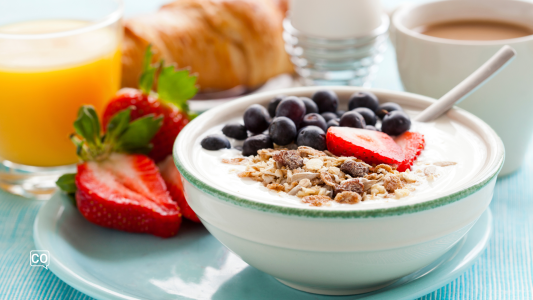
Nella pausa molti colleghi vanno al piccolo bar dell'ufficio. La mattina io prendo sempre un e un cornetto. Un collega preferisce il senza zucchero e un bicchiere d' . Un'altra collega beve solo caldo e mangia una fetta di con .
A pranzo il bar offre due piatti semplici: al o una grande insalata mista con d'oliva. Di solito la pasta e acqua naturale, ma qualche volta prendo anche un bicchiere di latte. Il bar non vende alcolici; è un posto tranquillo per mangiare, parlare con i colleghi e poi tornare al lavoro.During the coffee break many colleagues go to the small office bar. In the morning I always have a cappuccino and a croissant. A colleague prefers coffee without sugar and a glass of water. Another colleague drinks only hot tea and eats a slice of bread with cheese.
At lunch the bar offers two simple dishes: pasta with tomato sauce or a big mixed salad with olive oil. I usually eat the pasta and drink still water, but sometimes I also have a glass of milk. The bar does not sell alcoholic drinks; it is a quiet place to eat, talk with colleagues, and then go back to work.
Exercise 3:
Listen and answer the questions
Instruction: Listen to the audio and answer the questions.
Fetching your corrections... Please don't close this page yet.
1. Cosa prende oggi la donna al bar?
2. Cosa mangia oggi l'uomo a pranzo?
Exercise 4: Verb conjugations
Instruction: Choose the correct solution
Fetching your corrections... Please don't close this page yet.
1. La mattina io ___ il cappuccino e mangio il pane con il formaggio.
(In the morning I ___ cappuccino and eat bread with cheese.)2. Al lavoro noi ___ solo acqua e non beviamo mai bibite zuccherate.
(At work we ___ only water and we never drink sugary drinks.)3. A pranzo Maria ___ l’insalata e il pomodoro, ma non mangia mai la pasta.
(For lunch Maria ___ salad and tomato, but she never eats pasta.)
Exercise 5:
Dialogue comprehension
Instruction: Practice the conversation with your teacher or fellow students.
Fetching your corrections... Please don't close this page yet.
Colazione al bar vicino all'ufficio
Marco, impiegato: Show Ciao Sara, prendo un caffè e un po' di pane con burro.
(Hi Sara, I'm having a coffee and a bit of bread with butter.)
Sara, collega: Show Ciao Marco, io bevo un cappuccino e mangio un cornetto, non prendo pane.
(Hi Marco, I drink a cappuccino and eat a croissant, I don't have bread.)
Marco, impiegato: Show A casa invece mangio formaggio e uova, ma qui solo caffè.
(At home instead I eat cheese and eggs, but here only coffee.)
Sara, collega: Show Io a casa bevo solo acqua; il latte non mi piace molto.
(At home I only drink water; I don't like milk very much.)
Open questions:
1. Che cosa beve Marco al bar?
What does Marco drink at the bar?
Pranzo veloce in mensa aziendale
Elena, consulente: Show Oggi mangio pasta al pomodoro e una piccola insalata.
(Today I'm eating pasta with tomato sauce and a small salad.)
Paolo, collega: Show Io mangio solo insalata e pane, niente pasta.
(I only eat salad and bread, no pasta.)
Elena, consulente: Show Da bere prendo acqua; il tè lo bevo di solito la sera.
(To drink I have water; I usually drink tea in the evening.)
Paolo, collega: Show Anch'io bevo acqua; il caffè lo prendo dopo pranzo.
(I drink water too; I have coffee after lunch.)
Open questions:
1. Che cosa mangia Elena a pranzo?
What does Elena eat for lunch?
Exercise 6: Respond to the situation
Instruction: Practice in pairs or with your teacher.
Fetching your corrections... Please don't close this page yet.
1. Sei al bar con un collega italiano. Lui/lei chiede: «Che cosa prendi da bere?». Rispondi e dì che cosa bevi adesso. (Usa: Bere, L'acqua, Il caffè)
(You are at the bar with an Italian colleague. He/she asks: «What do you have to drink?». Answer and say what you are drinking now. (Use: Bere, L'acqua, Il caffè))Adesso bevo
(Now I drink ...)Example:
Adesso bevo un caffè, ma di solito bevo anche molta acqua.
(Now I drink a coffee, but usually I also drink a lot of water.)2. Sei in mensa al lavoro. Un collega ti chiede: «Che cosa mangi oggi a pranzo?». Rispondi e descrivi il tuo piatto. (Usa: Mangiare, La pasta, L'insalata)
(You are in the cafeteria at work. A colleague asks you: «What are you eating today for lunch?». Answer and describe your dish. (Use: Mangiare, La pasta, L'insalata))Oggi mangio
(Today I eat ...)Example:
Oggi mangio la pasta e un po' di insalata.
(Today I eat pasta and a bit of salad.)Exercise 7: Writing correspondence
Instruction: Write a reply to the following message appropriate to the situation
Fetching your corrections... Please don't close this page yet.
Ciao, sono Chiara, la tua nuova collega 😊
Domani a pranzo alcuni di noi mangiano insieme in ufficio. Io porto pasta e una piccola insalata con pomodoro e olio d'oliva.
Tu di solito cosa mangi a pranzo? E cosa bevi? Acqua, tè, caffè o altro?
Scrivimi, così organizziamo 😊
Hi, I’m Chiara, your new colleague 😊
Tomorrow at lunch some of us are eating together in the office. I’m bringing pasta and a small salad with tomato and olive oil.
What do you usually eat for lunch? And what do you drink? Water, tea, coffee or something else?
Write back, so we can organize 😊
Useful phrases:
-
Di solito a pranzo mangio...
(Usually for lunch I eat...)
-
A pranzo bevo...
(At lunch I drink...)
-
Mi piace..., ma non mi piace...
(I like..., but I don't like...)
grazie per il messaggio.
Di solito a pranzo mangio pasta o pane con formaggio e un'insalata con pomodoro. Bevo soprattutto acqua, ma qualche volta prendo un caffè.
Mi piace l'idea di mangiare insieme. Domani va bene per me.
A domani,
[Il tuo nome]
Hi Chiara,
thank you for the message.
Usually for lunch I eat pasta or bread with cheese and a salad with tomato. I mostly drink water, but sometimes I have a coffee.
I like the idea of eating together. Tomorrow works for me.
See you tomorrow,
[Your name]
Learn Italian for beginners - A structured A1 course for work & daily life
ISBN 979-13-88253-03-4
This app supports this book.