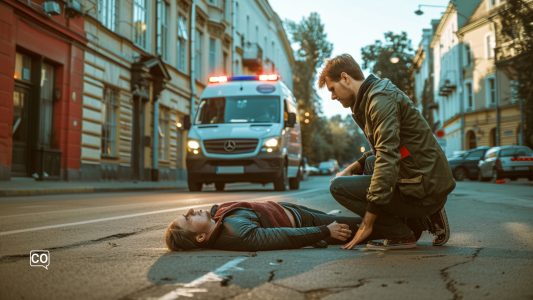
Emergency services
Get your bookA man sees an emergency at Köln Hauptbahnhof and calls the emergency number.
Exercise 1: Language immersion
Instruction: Watch the video and answer the related questions.
Fetching your corrections... Please don't close this page yet.
| Word | Translation |
|---|---|
| Der Notarzt | The emergency doctor |
| Der Rettungswagen (RTW) | The ambulance (RTW) |
| Der Einsatz | The call-out |
| Bewusstlos | Unconscious |
| Die Brustschmerzen | The chest pain |
| Die Medikamente | The medications |
| Die Maßnahmen | The measures |
| Die Situation | The situation |
1. In welchen Fällen wird oft direkt ein Notarzt gerufen?
(In which cases is an emergency doctor often called right away?)2. Warum kommt der Notarzt manchmal erst später?
(Why does the emergency doctor sometimes come only later?)3. Was macht das Team, wenn Medikamente und Maßnahmen nicht ausreichen?
(What does the team do when medications and measures are not enough?)Exercise 2: Dialogue
Instruction: Read the dialogue and answer the questions.
Fetching your corrections... Please don't close this page yet.
Ein Mann sieht einen Notfall am Kölner Hauptbahnhof und ruft den Notruf.
| 1. | Thomas: | Hallo, hier ist der Notruf. Was ist passiert? | (Hello, this is the emergency number. What happened?) |
| 2. | Luna: | Hallo, ich brauche dringend Hilfe. | (Hello, I urgently need help.) |
| 3. | Thomas: | Bitte bleiben Sie ruhig. Was ist genau passiert? | (Please stay calm. What exactly happened?) |
| 4. | Luna: | Ein Mann ist bewusstlos geworden und plötzlich auf den Boden gefallen. | (A man lost consciousness and suddenly fell to the ground.) |
| 5. | Thomas: | Atmet er noch? | (Is he still breathing?) |
| 6. | Luna: | Ja, er atmet noch, aber die Situation war sehr schlimm. | (Yes, he is still breathing, but the situation was very bad.) |
| 7. | Thomas: | Wo sind Sie gerade? | (Where are you right now?) |
| 8. | Luna: | In Köln, am Hauptbahnhof, vor der Bratwurstbude. | (In Cologne, at the central station, in front of the bratwurst stand.) |
| 9. | Thomas: | Gut. Wir schicken sofort einen Krankenwagen und einen Notarzt. | (Good. We are sending an ambulance and an emergency doctor immediately.) |
| 10. | Luna: | Soll ich bei ihm bleiben und versuchen zu helfen? | (Should I stay with him and try to help?) |
| 11. | Thomas: | Ja, bleiben Sie bitte dort und helfen Sie. Der Krankenwagen bringt ihn später in die Notaufnahme. | (Yes, please stay there and help. The ambulance will take him to the emergency department later.) |
1. Wo ist Luna gerade?
(Where is Luna right now?)2. Was schickt Thomas?
(What is Thomas sending?)Exercise 3: Use the website or the reading text
Instruction: On the subway, a man collapses and does not respond.
Fetching your corrections... Please don't close this page yet.
Show/hide translationsTask: Schreibe die fünf Schritte der Herzdruckmassage in der richtigen Reihenfolge und notiere, wann du den Notruf wählst.
URL: Die Herzdruckmassage
Use in your answer: Prüfen / Hilfe rufen / Notruf / Notarzt rufen / Herzdruckmassage durchführen / jede Sekunde zählt
Learn German A2 elementary: complete course with app and exercises
ISBN 979-13-88253-55-3
This app supports this book.