A1.15 - Daily food - Exercises
Exercise 1: Match a word
Instruction: Match each beginning with its correct ending.
Fetching your corrections... Please don't close this page yet.
Exercise 2:
Exam preparation 
Instruction: Read the text, fill in the gaps with the missing words, and answer the questions below
Fetching your corrections... Please don't close this page yet.
Folder van de bedrijfskantine: dagelijks eten
Welkom in de bedrijfskantine!
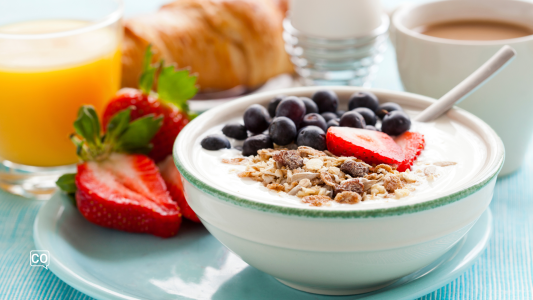
Elke ochtend serveren we een eenvoudig Nederlands . U kunt een met nemen en daarbij , of drinken. Er is ook . In de pauze kunt u eten, bijvoorbeeld een of een .
Voor het thuis koopt u gemakkelijk eten in de supermarkt. Veel mensen eten met groente, bijvoorbeeld tomaat, komkommer of . U kunt ook brood met kaas eten als u weinig tijd heeft. Let op: sommige gerechten zijn zout, dus proef eerst even. Eet en drink rustig en geniet van uw maaltijd.Welcome to the company canteen!
Every morning we serve a simple Dutch breakfast. You can take a sandwich with cheese and drink coffee, tea, or water with it. There is also milk. During the break you can eat fruit, for example an apple or a banana.
For dinner at home you can easily buy food in the supermarket. Many people eat potatoes with vegetables, for example tomato, cucumber, or lettuce. You can also eat bread with cheese if you have little time. Note: some dishes are salty, so taste first. Eat and drink calmly and enjoy your meal.
Exercise 3:
Listen and answer the questions
Instruction: Listen to the audio and answer the questions.
Fetching your corrections... Please don't close this page yet.
1. Wat neemt Noor mee naar het ontbijt op het werk?
2. Wat drinkt de man bij zijn avondeten?
Exercise 4: Verb conjugations
Instruction: Choose the correct solution
Fetching your corrections... Please don't close this page yet.
1. Ik ___ thuis en ik drink een kop koffie.
(I ___ at home and I drink a cup of coffee.)2. In het weekend ___ we laat, maar we drinken veel thee.
(On the weekend we ___ late, but we drink a lot of tea.)3. Mijn collega ___ water of hij drinkt melk bij zijn lunch.
(My colleague ___ water or he drinks milk with his lunch.)
Exercise 5:
Dialogue comprehension
Instruction: Practice the conversation with your teacher or fellow students.
Fetching your corrections... Please don't close this page yet.
Ontbijt kiezen in het hotel
Eva (collega): Show Goedemorgen Mark, wat neem jij bij het ontbijt?
(Good morning Mark, what do you have for breakfast?)
Mark (collega): Show Goedemorgen Eva, ik neem brood met kaas en een ei.
(Good morning Eva, I have bread with cheese and an egg.)
Eva (collega): Show Lekker. Ik eet een appel en een banaan, en ik drink koffie.
(Nice. I eat an apple and a banana, and I drink coffee.)
Mark (collega): Show Ik drink liever thee of water, geen koffie.
(I prefer tea or water, no coffee.)
Open questions:
1. Wat eet Mark bij het ontbijt?
What does Mark eat for breakfast?
Avondeten met je huisgenoot
Sara (huisgenoot): Show Jasper, wat eten we vanavond? Ik heb aardappels, tomaten en sla.
(Jasper, what are we eating tonight? I have potatoes, tomatoes, and lettuce.)
Jasper (huisgenoot): Show Laten we aardappels met tomaat en komkommer maken, en wat zout erbij.
(Let's make potatoes with tomato and cucumber, and some salt with it.)
Sara (huisgenoot): Show Goed idee. Ik bak er ook paprika en ui bij.
(Good idea. I'll also fry some bell pepper and onion with it.)
Jasper (huisgenoot): Show Top. Dan drink ik een glas melk. Jij neemt water?
(Great. Then I'll drink a glass of milk. You're having water?)
Open questions:
1. Welke groenten noemen Sara en Jasper? Noem er twee.
Which vegetables do Sara and Jasper mention? Name two.
Exercise 6: Respond to the situation
Instruction: Practice in pairs or with your teacher.
Fetching your corrections... Please don't close this page yet.
1. Je bent op kantoor. Het is ochtend. Een collega vraagt: "Wat eet jij meestal als ontbijt?" Antwoord en vertel kort wat je normaal eet. (Gebruik: het ontbijt, eten, de koffie)
(You are at the office. It is morning. A colleague asks: "What do you usually eat for breakfast?" Answer and briefly say what you normally eat. (Use: breakfast, eating, the coffee))Voor het ontbijt
(For breakfast ...)Example:
Voor het ontbijt eet ik brood en drink ik koffie.
(For breakfast I eat bread and drink coffee.)2. Je bent in de supermarkt na het werk. Je hebt geen tijd om lang te koken. Je vraagt een winkelmedewerker om een idee voor een snelle maaltijd met groenten. (Gebruik: de tomaat, de komkommer, het avondeten)
(You are in the supermarket after work. You don't have time to cook for long. You ask a store employee for an idea for a quick meal with vegetables. (Use: the tomato, the cucumber, dinner))Voor het avondeten
(For dinner ...)Example:
Voor het avondeten neem ik brood met tomaat en komkommer.
(For dinner I take bread with tomato and cucumber.)Exercise 7: Writing correspondence
Instruction: Write a reply to the following message appropriate to the situation
Fetching your corrections... Please don't close this page yet.
Hoi! Ik ben nog op kantoor. Kun jij straks even langs de supermarkt?
We hebben thuis nog brood en kaas, maar geen eieren en geen melk. Ik wil vanavond iets simpels: aardappels met sla en tomaat.
Wil jij thee of koffie na het eten? Ik neem zelf water.
Dank je!
Groetjes, Marloes
Hi! I'm still at the office. Can you stop by the supermarket later?
We still have bread and cheese at home, but no eggs and no milk. I want something simple tonight: potatoes with lettuce and tomato.
Would you like tea or coffee after dinner? I'll have water myself.
Thanks!
Best wishes, Marloes
Useful phrases:
-
Ik kan straks ... halen.
(I can get ... later.)
-
Ik eet vanavond ... en ik drink ...
(I’m eating ... tonight and I’m drinking ...)
-
Wil je liever ... of ...?
(Would you rather have ... or ...?)
Ja, ik kan straks naar de supermarkt. Ik haal eieren en melk en ik neem ook tomaat en sla mee. Vanavond eet ik aardappels met sla en tomaat. Ik drink water en na het eten wil ik graag thee.
Groetjes,
Hi Marloes,
Yes, I can go to the supermarket later. I'll get eggs and milk and I'll also take tomato and lettuce. Tonight I'm eating potatoes with lettuce and tomato. I'll drink water and after dinner I would like tea.
Best wishes,
Dutch for beginners: Learn with a complete A1-course (CEFR)
ISBN 979-13-88253-56-0
This app supports this book.